I do most of my word family teaching with the Words Your Way Spelling. When the students get to the sort, I teach them that word family (or those word families). Of course, I continually practice them with the students who need more practice with them.
When my Kindergartners are ready to learn digraphs and dipthongs, I teach those as a whole class even if some of my students are still on basic word families. Introduction is never a bad thing in my opinion, I just don't hold them to knowing those if they are still learning og family (example). It won't hurt them getting the lesson and practice though!
I found a website where I use 1-2 pages from her downloads as worksheets while we're learning that digraph or dipthong. I do not have the time nor the desire to do so many worksheets. But I do like the cut and paste word with picture page for all my students and the sentence page for my higher group. I do like that she has picture and word cards - this will save me from writing the words on the white board everyday. These items are in her "sets" as she calls them. Click here for the website.
When I start to teach these dipthongs, usually more than half my class are ready to read a lot more than 1 sentence per page. Plus I wanted to start saving paper. Instead I wrote little stories to send home as a practice/homework. They have a word bank with the dipthong words. Then the story. On the back, I print the questions that go with the story. This way it practices similar concepts as my sight word books. It is just a tad harder now... being paragraphs - but I believe is doable.
Sunday, March 18, 2012


St. Patrick's Day
I love how this turned out. At first, I was quite frustrated with the fact that the color printer at the school was not working for a few days which meant I could not print and laminate my St. Patrick's Day games for the kiddos. However, it was changed for the UPSIDE! Keep reading.
On St. Patrick's Day: (or closest day)
Wear lots of green (I love to wear crazy outfits on these days.) Students included of course~
Write a letter as a class to the leprechaun in case he comes to visit our classroom. We write a letter based on what we know about him. We informed him or asked him of something related to what we already knew. Our letter had to be short because it was taking too long for my students to do the writing.
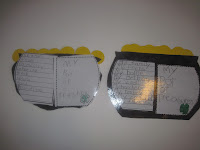
Make their pots of gold filled with their treasures. I downloaded this template for free of TPT. I tweaked it a little to fit what I wanted to do for my class. St. Patrick's Day was on a Saturday, so this was a perfect activity for my Friday. The students wrote a list of their treasures in life. Then they glued gold coins on their pots for every treasure they wrote. This inspired a long list! (I laminated their pots because I thought their lists of treasures would be a great memory piece.)

Day after St. Patrick's Day (over the weekend in 2012):

Leprechaun messes up our classroom:
The kids come in and some things are a mess! The calendar is upside down, posters are upside down, and all our chairs are stacked which we never do! Our color crayons on the cabinets are all over the classroom instead! There are a few other items. I immediately asked the kids why they made a mess. They swear it wasn't them, but I just don't believe them! They point out a letter left by the leprechaun. OH, THAT EXPLAINS IT! The kids didn't make a mess. To add to the fun, there are boot prints and a couple hand prints all over the classroom, showing where the leprechaun went running. To add to THAT FUN - all adults that enter my class CAN'T see the leprechaun foot prints and hand prints. This drive the kids NUTS! I just LOVE it! The next day, a few footprints aren't there anymore and then the next day they are all gone.


The leprechaun leaves us a GIFT!
Leprechaun's mess up things and trick us, that's just what they like to do. However, the leprechaun that visited our class wrote a little extra note telling us that he left us some games to play for the rest of the month! (It worked out perfectly to have games made up late... we could use them for a couple more weeks because the Leprechaun gave them to us.) Mr. Leprechaun gave us green playdough because he loves green. He gave us yellow with gold sparkles to us to make gold coins for the pots. Playdough had GLITTER!


 The leprechaun also left us supplies to make Leprechaun Juice! We just needed to write out the directions!
Other activities:
Writing:
How would you catch a Leprechaun?
What would you want to find at the end of a rainbow?
How to make Leprechaun Juice!
 Reading:
The Little Leprechaun (A rebus story)
I'm a Little Leprechaun Poem
ar/oo gold coins
Art & Writing:
My Pot of Treasures (shown above)
Art and Sight Words:
Sight word Shamrock Surprise
Paint a rainbow
Math:
St. Patrick's Day Patterns
100 clovers
Pots of Gold - Students pick up some gold coins in 2 groups and then adds the coins together (recording sheet)
Rainbow coloring sheet: I wrote in color words to help them practice
Have you ever seen a Rainbow? graph
I found almost all of my printables on TPT... no time this time to make stuff myself. Plus so many great activities and games out there!


On St. Patrick's Day: (or closest day)
Wear lots of green (I love to wear crazy outfits on these days.) Students included of course~
Write a letter as a class to the leprechaun in case he comes to visit our classroom. We write a letter based on what we know about him. We informed him or asked him of something related to what we already knew. Our letter had to be short because it was taking too long for my students to do the writing.
Make their pots of gold filled with their treasures. I downloaded this template for free of TPT. I tweaked it a little to fit what I wanted to do for my class. St. Patrick's Day was on a Saturday, so this was a perfect activity for my Friday. The students wrote a list of their treasures in life. Then they glued gold coins on their pots for every treasure they wrote. This inspired a long list! (I laminated their pots because I thought their lists of treasures would be a great memory piece.)


Day after St. Patrick's Day (over the weekend in 2012):

Leprechaun messes up our classroom:
The kids come in and some things are a mess! The calendar is upside down, posters are upside down, and all our chairs are stacked which we never do! Our color crayons on the cabinets are all over the classroom instead! There are a few other items. I immediately asked the kids why they made a mess. They swear it wasn't them, but I just don't believe them! They point out a letter left by the leprechaun. OH, THAT EXPLAINS IT! The kids didn't make a mess. To add to the fun, there are boot prints and a couple hand prints all over the classroom, showing where the leprechaun went running. To add to THAT FUN - all adults that enter my class CAN'T see the leprechaun foot prints and hand prints. This drive the kids NUTS! I just LOVE it! The next day, a few footprints aren't there anymore and then the next day they are all gone.


The leprechaun leaves us a GIFT!
Leprechaun's mess up things and trick us, that's just what they like to do. However, the leprechaun that visited our class wrote a little extra note telling us that he left us some games to play for the rest of the month! (It worked out perfectly to have games made up late... we could use them for a couple more weeks because the Leprechaun gave them to us.) Mr. Leprechaun gave us green playdough because he loves green. He gave us yellow with gold sparkles to us to make gold coins for the pots. Playdough had GLITTER!


Other activities:
Writing:
How would you catch a Leprechaun?
What would you want to find at the end of a rainbow?
How to make Leprechaun Juice!

The Little Leprechaun (A rebus story)
I'm a Little Leprechaun Poem
ar/oo gold coins
Art & Writing:
My Pot of Treasures (shown above)
Art and Sight Words:
Sight word Shamrock Surprise
Paint a rainbow
Math:
St. Patrick's Day Patterns
100 clovers
Pots of Gold - Students pick up some gold coins in 2 groups and then adds the coins together (recording sheet)
Rainbow coloring sheet: I wrote in color words to help them practice
Have you ever seen a Rainbow? graph
I found almost all of my printables on TPT... no time this time to make stuff myself. Plus so many great activities and games out there!


Tuesday, February 21, 2012
100th Day
I'm 100 Years Old Dress Up
 100 Mask
100 Fruit Loop necklace - I'm 100 days smarter tag and count out 100 fruit loops!
100 Writing Book
- If I had $100
- What will I look like at 100 yrs old
- I can write my numbers to 100 - 100
number chart
100 Exercises - The students use the exercise cards and do 10 excercises 10 times. If the card says jumping jacks, they do 10 jumping jacks.
100 Steps - Where will you end up? (map skills) The students got a map of the school. (The school I am this year is quite confusing with lots of different corridors to go down.) When we exit our room, there are 3 different corridors to go down. We vote and choose which one to go down and continue making our choices till we reach 100 steps. Everytime we come to a corridor, the students use their crayon to draw on their map what we just did. My students LOVED this!
My 100 Snack- We had 10 different food items to go into the trail mix on 10 plates. The students had to count out 10 of each item to put in their trail mix baggie! YUM!
Jump for 100 seconds!

100 Fruit Loop necklace - I'm 100 days smarter tag and count out 100 fruit loops!
100 Writing Book
- If I had $100
- What will I look like at 100 yrs old
- I can write my numbers to 100 - 100
number chart
100 Exercises - The students use the exercise cards and do 10 excercises 10 times. If the card says jumping jacks, they do 10 jumping jacks.
100 Steps - Where will you end up? (map skills) The students got a map of the school. (The school I am this year is quite confusing with lots of different corridors to go down.) When we exit our room, there are 3 different corridors to go down. We vote and choose which one to go down and continue making our choices till we reach 100 steps. Everytime we come to a corridor, the students use their crayon to draw on their map what we just did. My students LOVED this!
My 100 Snack- We had 10 different food items to go into the trail mix on 10 plates. The students had to count out 10 of each item to put in their trail mix baggie! YUM!
Jump for 100 seconds!
President's Day
1 Day:
Introduction about our country and our beginning story. How and why we fought for our freedom. Brief introduction to our nation's symbols. I read a book that has beautiful pictures of America. We listen to America the Beautiful and watch a clip on YouTube.
1-2 Days:
FLAG: Meanings and purpose
The students use prepared construction paper to create the USA flag.
The story about how the Star Spangled Banner song was written.
We listen to the Star Spangled Banner.
The next day, the students learn about the Pledge of Allegiance in simple terms.
We fill in the blanks for the "easier" words.
 How to: Make a Graham Cracker Flag
Students write how to make a flag with a graham cracker. (I guide this one)
I used this as a shared writing activity with my small groups. They helped spell words and they spelled words on their own.
(This was an idea from a co-worker)
1 Day:
Eagle
2 Days:
Statue of Liberty: Story of her as our gift from France.
Students were given some fantastic playdough (that will dry well), but you can use molding clay. Using pictures of the Statue of Liberty, the students were to mold their own statue. Then they learn about the coloring of the Statue from the science experiment - to finish they paint their Statue of Liberty!
What happened to the color of the Statue of Liberty
Penny/Statue of Liberty Science Experiment
Paint students' Statue of Liberty a light shade of green
Liberty Bell:
The Liberty Bell Video
Presidents:
Abraham Lincoln:
Biography of Abe book (for younger kids)
Abraham Portrait & sentence blanks (info about Abe) - Shared Reading and writing
 His hair was created with torn up brown construction pieces.
(I'll get a picture next time!)
George Washington:
Video Biography
George Portrait & sentence blanks (info about George) - Shared Reading and writing
His hair was done with a mix of glue and paint to give some 3D feel to it. (need more glue next time)
Introduction about our country and our beginning story. How and why we fought for our freedom. Brief introduction to our nation's symbols. I read a book that has beautiful pictures of America. We listen to America the Beautiful and watch a clip on YouTube.
1-2 Days:
FLAG: Meanings and purpose
The students use prepared construction paper to create the USA flag.
The story about how the Star Spangled Banner song was written.
We listen to the Star Spangled Banner.
The next day, the students learn about the Pledge of Allegiance in simple terms.
We fill in the blanks for the "easier" words.

Students write how to make a flag with a graham cracker. (I guide this one)
I used this as a shared writing activity with my small groups. They helped spell words and they spelled words on their own.
(This was an idea from a co-worker)
1 Day:
Eagle
2 Days:
Statue of Liberty: Story of her as our gift from France.
Happy 125th birthday, Statue of Liberty
Mold Statue of Liberty.Students were given some fantastic playdough (that will dry well), but you can use molding clay. Using pictures of the Statue of Liberty, the students were to mold their own statue. Then they learn about the coloring of the Statue from the science experiment - to finish they paint their Statue of Liberty!
What happened to the color of the Statue of Liberty
Penny/Statue of Liberty Science Experiment
Paint students' Statue of Liberty a light shade of green
Liberty Bell:
The Liberty Bell Video
Presidents:
Abraham Lincoln:
Biography of Abe book (for younger kids)
Abraham Portrait & sentence blanks (info about Abe) - Shared Reading and writing
 His hair was created with torn up brown construction pieces.
 (I'll get a picture next time!)
George Washington:
Video Biography
George Portrait & sentence blanks (info about George) - Shared Reading and writing
His hair was done with a mix of glue and paint to give some 3D feel to it. (need more glue next time)
Friday, February 17, 2012
Class Letter from Teacher
I do love this idea. I write my Kinder students a letter on the white board. I then ask students t raise their hands if they can help read a word. The kids take turns reading 1 word found in the story, I underline the words they say. I usually call on my lower readers to get those sight words first in the letter. (Depends on dynamics of my letter.) We look back over the words they couldn't figure out. We sound out the ones that can be and the ones they can't, I tell them or we use context clues to guss. We practice reading those tough words once or twice. As a class, we read the letter twice.
I love that I can do lots of positive reinforcing with this activity and practice fluency and sounding out.
On the days I should have written a letter, but forgot, I make it a shared writing. They are to help "remind me" how to format the letter. They tell me how to start the letter (Dear _____,) and end (Love, )
I love that I can do lots of positive reinforcing with this activity and practice fluency and sounding out.
On the days I should have written a letter, but forgot, I make it a shared writing. They are to help "remind me" how to format the letter. They tell me how to start the letter (Dear _____,) and end (Love, )
Student Compliment Notes
I ask a student to go into another K class and help that teacher with something. The other teacher also sends a student into my class to help me with something. During this time (which we do the first 15 minutes of class), we (the class) writes a Compliment Note together.
I use my doc camera to display the writing page. The students raise their hands and give a compliment (says something nice) about that person. The class is asked to help me spell words by using our word wall. If the sight word is not up there, then I direct them in how to spell something out. They tell me what they think and I write it.

Example: sweet was originally spelled s-w-e-t; However, after teaching them the long /e/ and the /ee/, my students now spell s-w-e-e-t without any help from me.
Example: I allowed my students to spell cute like: c-o-o-t because we had learned of the /oo/ sounds. After writing it so often, I have showed them the proper way and added it to our word wall. This way they could start spelling it correctly using the word wall!
My students have caught on to the fact that leaving the room means they get written about, so I hold the letters till Friday and by that time they had forgotten about their letter. When it is time to do our shared reading, I ask the student the letter is about to stand up and we (as a class) read the letter to that student. They get to take the letter home and read it all by themselves.
Friday is a great time to point out the punctuation, capitals, and spaces between words. I have really grown to love this activity. I will be starting this WAY earlier next year. I won't do this every day, but 2-3 times a week.
Our 2nd letter will be even more detailed! I will ask student writers to write the sentences and do their best spelling (asking the class for help when they want). I think this will be FANTASTIC practice.
I use my doc camera to display the writing page. The students raise their hands and give a compliment (says something nice) about that person. The class is asked to help me spell words by using our word wall. If the sight word is not up there, then I direct them in how to spell something out. They tell me what they think and I write it.

Example: sweet was originally spelled s-w-e-t; However, after teaching them the long /e/ and the /ee/, my students now spell s-w-e-e-t without any help from me.
Example: I allowed my students to spell cute like: c-o-o-t because we had learned of the /oo/ sounds. After writing it so often, I have showed them the proper way and added it to our word wall. This way they could start spelling it correctly using the word wall!
My students have caught on to the fact that leaving the room means they get written about, so I hold the letters till Friday and by that time they had forgotten about their letter. When it is time to do our shared reading, I ask the student the letter is about to stand up and we (as a class) read the letter to that student. They get to take the letter home and read it all by themselves.
Friday is a great time to point out the punctuation, capitals, and spaces between words. I have really grown to love this activity. I will be starting this WAY earlier next year. I won't do this every day, but 2-3 times a week.
Our 2nd letter will be even more detailed! I will ask student writers to write the sentences and do their best spelling (asking the class for help when they want). I think this will be FANTASTIC practice.
Calendar Challenge
In our Kindergarten, the kids should learn the days of the week. Doing calendar every day will help this. After regular calendar, we sing the Days of the Week song. About half way through the year, we add to that song and sing the months of the year song. Something I should have started early is our Calendar Challenge. My students look forward to it. Probably because I give them my "questioning" look and I say: "Are you ready for your calendar challenge?" (Of course, I add in a couple eye brow raises.)
Calendar Challenge: I ask them to point to where we find the month, show me 1 day on the calendar, and show me a full week on the calendar. I will also ask how many days are in a week. Plus, I ask the student to point to today and then slide their finger up to find what day of the week it is. We look at the word and try to figure it out based on the first few letters. Now that my Kinder Kids are getting these concepts, I will be adding to our challenge questions such as what day is before or after. I will also ask how many Mondays we've had in the month. Find the first day of the month, what day did the month start on.
I definitely ask the same basic questions to all my students, but those that can handle more or need of a challenge rather than a review are given one according to how I feel they will still feel successful.
Calendar Challenge: I ask them to point to where we find the month, show me 1 day on the calendar, and show me a full week on the calendar. I will also ask how many days are in a week. Plus, I ask the student to point to today and then slide their finger up to find what day of the week it is. We look at the word and try to figure it out based on the first few letters. Now that my Kinder Kids are getting these concepts, I will be adding to our challenge questions such as what day is before or after. I will also ask how many Mondays we've had in the month. Find the first day of the month, what day did the month start on.
I definitely ask the same basic questions to all my students, but those that can handle more or need of a challenge rather than a review are given one according to how I feel they will still feel successful.
Subscribe to:
Posts (Atom)

 Posts
Posts

