CLICK HERE FOR FREE BLOGGER TEMPLATES, LINK BUTTONS AND MORE! »

Thursday, July 5, 2012

Color Coordinated Sight Words


Colored cans... student names get switched over to the colored can of the sight words they are practicing. These cans are used for my knowledge, but also for those parents and other volunteers that show up unexpected. I tell them which colored can to pull students from. If it is the orange can, then they can do the orange sight word flashcards and the orange books.

Colored Flashcards:
I make a teacher set of my sight words on their coordinated color. This way I just grab the color I need to teach or grab the color we need to review. If you don't want to use your teacher set of flashcards for student use, you can make a separate set with paint sample cards -- super quick and easy --- they will be worn down, but that is ok to me... better those than my flashcards.


Sight Word Books color coordinated with ribbon.
If a student still needs practice reeading from the yellow group, then a parent helper or other volunteer knows which books to practice reading from (so I don't have to spend time explaining and getting the books for them.)  All my sight word books are in my Sight Word Sets 1-4.

Sight Word Sticks:
You can use these sticks in a variety of ways. I write my sight words on the correct color stick to match the set they are in. You can use the sticks for all sorts of games.  Matching, KABOOM (sight words not sentences), Drop Sticks, Build a Fire (students pull sticks and if they can read the sight word, they keep the stick and get to build a fire), Guess my Word (students give clues to the word on their stick), and I am sure their are plenty more!
Sight Word Poems: in colored files 
I have these printed and organized according to each sight word. I need to switch the words to the correct colored files and tabs for the sets. Yet another practice parents can pull and practice with students. OR I can send these pages home with students for homework or use in my groups. Differentiate!

My Tic Tac Toe pages are printed on their correct set color.

BINGO game boards are also printed on their correct set color, so during centers the adult or myself can differentiate the groups and practice the words that that group is practicing. All kids get to play BINGO, just with the correct words they are reviewing! Plus it is simple to write down which group is on which color for the adult helping at the BINGO center.

Fluency Cards: My words are printed on the correct color (plus they have some review words from previous sets). All the colors are in the chair pockets. Each group knows which color they need to pull out when it is time to do fluency practice, so I don't need to get it out or try to figure out which groups need which fluency cards.

Sentence Strips: The sentences are similar to the KABOOM sentences. They focus on the words in the color set and words from previous sets. Sentences are on the color strip so I know which set they belong to.


Sight Word Program

I love my organization for Sight Words. I have them separated into colors. They are organized into the order that I feel works for reading and writing simple sentences into more complex ones. Each sight word has a book to go with it, and the books get harder throughout the order. I have gotten loads of compliments on my sight word books mostly because of the last page (the homework page).

The units are color coordinated, so I know when I am moving on to the next set. This helps me identify which students need to work on which set of words. It makes it super easy when I parent randomly shows up to help...  I Just pull out my students who are slightly behind the class set and they get to work on the words in that set with flashcards, reading the books, or playing a game with those specific words.  Check out pictures of the color coordinating idea on the Color Coordinated Sight Words post.

Unit 1: like, my, see, a, and, have, do, to
RED (Everything I make for unit 1 sight words is in red for a quick grab.)
These words were chosen first to teach because they use these words first in sentence writing for their journals and opinions.

Unit 2: is, the, he, she, play, go, can, you, said
(I teach be and me with he/she although they are not my focus sight words... I use this to introduce how great word families can be!)
ORANGE
These words connected well with the first set and within other words in this set.
I also teach his with the word is.

Unit 3: on, with, will, for, are, was, has
YELLOW
I teach -as- with the word -has-. I actually teach has and was the same time and don't connect a letter to one of them.. I usually review is, has, as, has and was at the same time because we read all the words regular until we get to WAS and we read it with a deap voice since it is different from the others, but still has the /z/ sound at the end. My students love reading WAS with a deap voice in their regular reading after that.

Unit 4: very, no, yes, that, of
Green
This unit is very small, but it concludes my specific reviewing of all the letters again. (I will continue review letters, but the ones any student behind still needs to learn or the letters that need help writing still.)

Blue unit: In this unit I teach more words, but also review digraphs and dipthongs in story writing. It gets a tad harder, but it uses word families in stories.

Words: here/there, who/what, from/all, because/your, they/when, would/which, way/make
Other: /ee/, /ew/, /oi/ and /oy/, /ar/, /au/, /aw/, /ow/
The order of these change according to what I feel the class needs.
The other sound stories are for group reading and then sent home as homework with questions about the story - just like the sight word books, but more complex.

Tuesday, April 17, 2012

Get to Know Me!

Mystery Box: Students decorate a shoe box and then fill it with items that show interests they have. (or just 1 item) They share with the class or in small groups about themselves. This box is then taken home and is where they store their sight words, reading books, alphabet cards, numbers ect.

Write lists of various common features or interests. Practice writing, counting, and identifying names.

Create graphs to show common interests. Practice counting, Math Talk, and opinion.

Partner Stories

Assign the students into partners.

I have done this 2 ways:
1. I partner up a higher writer with an average or lower student. The higher writer is assigned the job or being the author while the other student is assigned to being the illustrator. Together they make a book!

2. Students pick their own partners. They create 2 books together. For 1 book 1 person is the author while the other is the illustrator, then they swap jobs for their 2nd book. The writer gets to keep the book they wrote!

Sight Word Ideas

Some games and activities to use with sight words.
Sight Word Pointers: (an idea shared by another teacher in my district)
Students get their own sight word stick that they get to take home and practice reading with it.
Example: Sight word stick says "the" and they point to items and read "the table," "the book," "the mom."

Sight Word Kaboom/Tic Tac Toe Class Games:
I have these in my units already organized in the order I have my sight words. Great filler or reward games.  These are top games choices when we have extra time or have an older student coming in for a few minutes.

Sight Word Journal: Read more about this under journal. I like how I connect my sight words with their journals. I also think the introduction of journals is pretty helpful for the kids who fight writing or think they can't write.

Sight Word Alphabox Detectives: Students fill sight words in the letter boxes. (or any other words they know how to read.) I give my students the alphabox and a handful of books. They get to use magnifying glasses to find the words.

Sight Word Hunts: The copies for this quick and fun center are in my units. Print the sight word you're learning and post all over the room. Students grab clipboards, fun glasses, and their page and pencil and start their search for the sight word. STUDENTS LOVE THIS!  It is super easy of a center and the kids don't get tired of it.

Sight Word Writing Worksheet:  I don't believe in a lot of worksheets for kids. I think they are boring and too much paper. However, I do think kids need practice writing their sight words and HeidiSongs has some gread worksheets to help practice. I believe in her books each sight word has up to 6 pages for that word, but I only choose 2 pages as to not overload my students.

Sight Word Card Games: You can find or make LOTS of other card games with sight words such as matching. There are so many other ones that I use that I have gotten from TPT that are just so creative that go with the holidays. There are too many holiday varieties, that I won't be listing them all.

Sight Word Slap It: My kids love this game.  Write a bunch of words on the white board. Pick 2 people to come up and "slap it" - the word you say. The students get to hold a fly swatter and the first one to slap the correct word gives their team a point.  This is the same as my table slap it except with fly swatters.

Sight Word Bird Hunt (I posted these parrots all over the school and a parent volunteer took them on a bird hunt around the school. The students wrote down the sight words as they found them!)


Sunday, April 1, 2012

Insects and Life Cycles

After teaching about plants, I teach a little about insects.

Ladybugs: Ladybugs are the protectors of leaves, so this is a great insect to start with!
Life Cycle and Count the Spots Worksheets
Buy Ladybugs from Earth's Birthday Project  (ladybug exploration with magnifying glasses)
Also explore with felt ladybugs to figure out what they can already tell from ladybugs
Ladybug cupcakes (Kids get to decorate their own cupcake like a ladybug!)
Ladybug Spots Equation
Ladybug Story "How do ladybugs get their spots?"
Books: Grouchy Ladybug, Ladybugs (Pebble Books), Ladybugs Red, Fiery, and Bright
     Teach:  Fiction vs Non Fiction    
     Venn Diagram Comparison about 2 of those books
     Grouchy Ladybug: Talk about times of the day and each student writes a page about what they do
        at their assigned time of the day to compile into a book.


Caterpillars
1. Read "A Very Hungry Caterpillar"
2. Make an accordion caterpillar book
    I made the book to practice base 20 math, but I'm sure  
    their are PLENTY of other ways to use this book.
3. Word caterpillar (Students add words to their caterpillar to show all the words they know!
(Sight Words, color words, number words)


Caterpillar Patterns: 
Students were given basic caterpillars and were to create a pattern using the dot paints. Some pages had specific patterns on them already (AB or ABC ect) while some were left blank. The day we did blank caterpillars the students were told to do at least 1 AABB and ABC pattern to ensure they had a guide. Something simple and fun.


Butterflies
Buy caterpillars that will metamorphosis right in front of your class in 2-3 weeks! 
Caterpillars turn into butterflies, so I go through their life cycle next.
Butterfly Book + Butterfly Wing Creation
Waterfall butterfly life cycle book.  (I place this book inside their large butterfly book.)

Materials needed:
large construction paper (any color)
copies of a butterfly cut in half
glue, scissors
coloring materials
variety of colored paper (optional)

Fold the construction paper where the 2 sides reach in to touch the middle. Glue each side of the butterfly on each flap. Decorate each butterfly wing with markers, crayons, paint, or tissue paper. Glue the waterfall page into the fold, so when you pull the butterfly wings apart, you find the butterfly life cycle.

Bees:
Watch Reading Rainbow - BEES  (3:45- 4:50)
Watch Magic School Bus - Bees  (I own the DVD)
Bees Knowledge Chart Poster
Bee paragraph (3 sentences: Bees have..., Bees are..., Bees can... 
(DO AS WHOLE GROUP since it is their first time using an organizer.)
Paper craft bee or paint a bee with information on the back.

Plants

Plants? Plants. Plants!

I bought the Pebble books to use throughout my unit, but it is not necessary.
As you keep reading below. If you are interested in this unit here is the link. Plants? Plants. Plants!
The link can also be found at the bottom.

What we know about plants: shared writing

Art project: I designed this art project to add to the parts of a plant as we learn about it. I liked the 3d aspect of it.

I teach 1 new part of the flower every day, so I don't overwhelm too much in 1 day.
1. Teach roots
2. Teach stem
3. Teach leaves (and veins)
4. Teach flower
5. Teach seeds

Every day the students add their plant information on with their addition to their art project.

These make for adorable classroom and hallway decor.


Flower Plant Book: Fill in the blanks to recap what they learned.

Flower Art Project and Expanded Sentences Activity:
This is where I teach that flowers have petals. (more vocabulary)


Trees and Art Project! I do this art project just to teach that trees have branches. We also talk about how sometimes we can see tree roots while sometimes we can't. I show them lots of pictures (via powerpoint) of various types of trees. Kids love to see different trees! This is a good time to also talk about how trees help us. (My class did posters for Earth Day telling how trees were helpful - a contest schoolwide/state too.)

Yum! Plants We Eat!  I can't find pictures from these activities, so I am guessing I forgot to take some. We did a lot of activities with this part. They are in my unit.

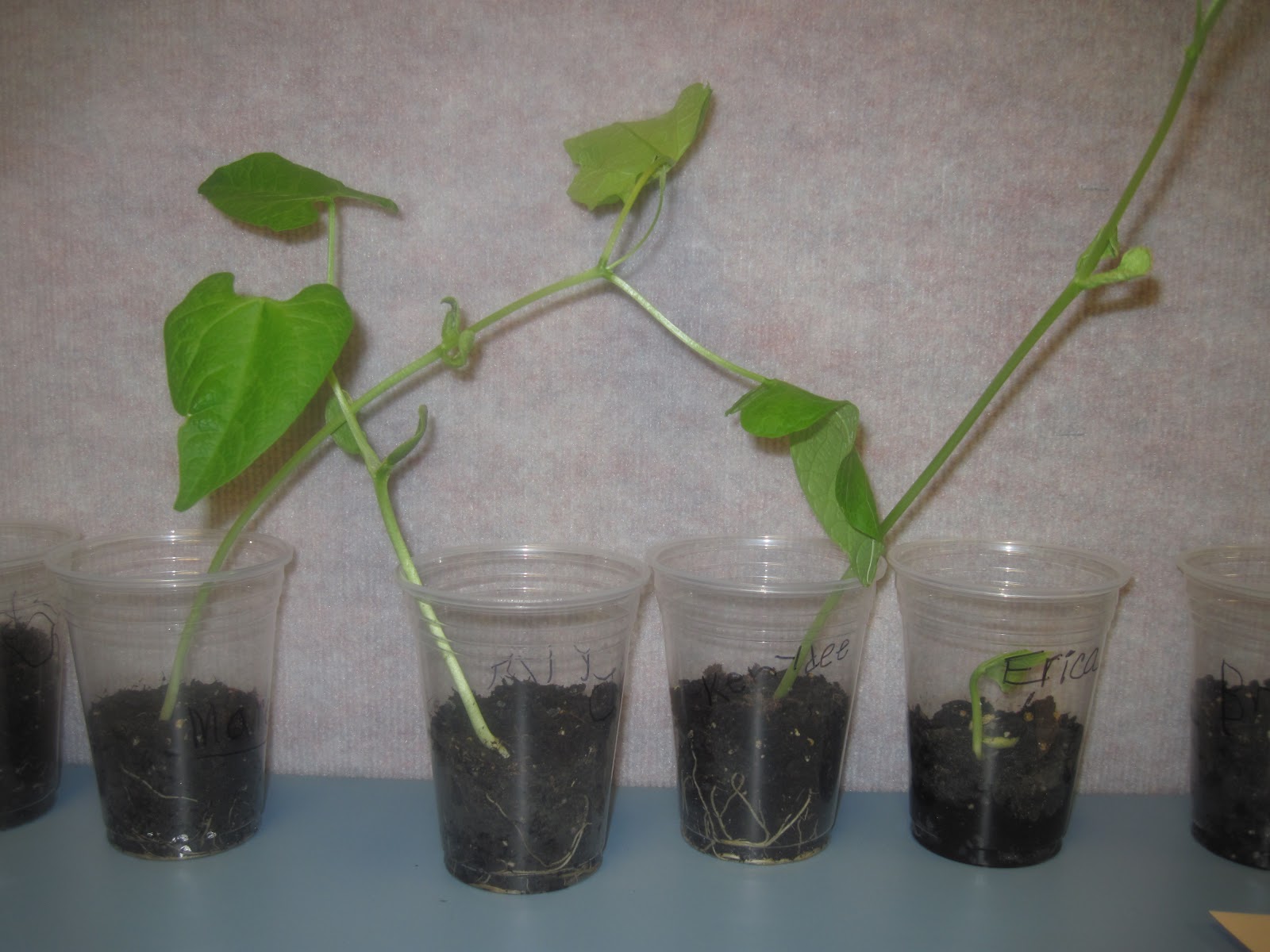
Growing Plants and Plant Journal: Students plant lima beans and watched them grow!  They record the growth in their journals.


We also talking about building/growing patterns where a pattern grows by one every day. (Part of the math curriculum we needed to teach)  I told and showed the students about a stem growing every day... then they did their own art project with it.


PLANT UNIT ON TPT